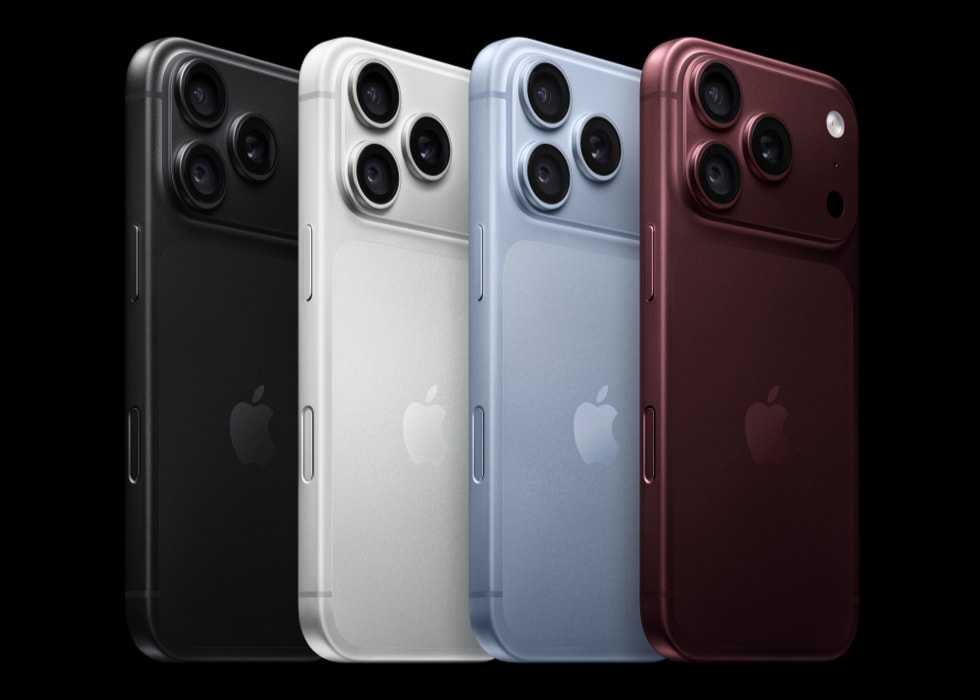
Apple's event ran at 3am our time this morning and the Pro phones came out much as expected. The iPhone 18 Pro starts at A$2,099 and the Pro Max at A$2,299, both up A$100 on last year. The headline is a main camera with a physical aperture that opens and closes, plus a big battery claim on the Pro Max. Here's what Apple has confirmed for Australia and what it hasn't.
Pre-orders open at 10pm AEST this Saturday, 12 September, and the phones are in stores on Friday 18 September. Four colours: black, silver, glacier and a new burgundy. Storage goes 256GB, 512GB, 1TB and 2TB. The A$2,099 and A$2,299 figures are the 256GB starting prices from Apple's Australian newsroom. Last year's 17 Pro started at A$1,999 and the 17 Pro Max at A$2,199, so it's A$100 more across the board this time. In the US the rise was also US$100, to US$1,199 and US$1,299.
The camera is the actual news
The 48 megapixel main camera now has a variable aperture, which is a first on an iPhone. Six blades sit inside the lens and open or close depending on the shot. Apple gives three examples: ƒ/1.48 wide open for low light, ƒ/1.8 for portraits, and ƒ/4 stopped down so more of a group photo stays sharp. There are four aperture settings you can pick by hand in the Camera app, and Apple has opened it up to third-party apps as well. The sensor is new too, and there's a new Pro controls layout with shutter speed, white balance and a histogram.
Two smaller camera things worth knowing. Cinematic mode effects can now be applied after you've shot the video, at up to 60fps. And there's a new Reference mode that signs every pixel the sensor captures, so you can prove a photo hasn't been edited. That one is opt-in and Apple says it isn't switched on at launch in China or the EU. Australia isn't mentioned either way.
Chip, cooling and the Dynamic Island
The A20 Pro is built on a 2 nanometre process. Apple's numbers: the 7-core GPU is up to 40 per cent faster than the A19 Pro, memory bandwidth is up 50 per cent, and the neural engine has doubled to 32 cores. The memory has moved out from over the chip so the chip can sit straight on a bigger vapour chamber, three times the surface area of the one in the 17 Pro. Apple claims up to 40 per cent better sustained performance from that. Those are Apple's figures, nobody outside Apple has tested them yet.
The Dynamic Island is smaller and can now show three Live Activities at once. Face ID is still there. There's a new N1 chip doing Wi-Fi 7, Bluetooth 6 and Thread, and a new C2 modem which Apple says uploads faster than last year's C1X while using 15 per cent less power.
Battery, and why the Australian number is a bit lower
Apple's big battery claims are 36 hours of video playback on the 18 Pro and 45 hours on the 18 Pro Max. Read the footnote though. Those figures are for the eSIM-only models, which are sold in the US, Canada, Japan, Mexico and a handful of Gulf countries. Australia is not on that list, so our phones keep the physical SIM tray, and Apple says the eSIM-only versions get two extra hours of video playback from the space the tray would have taken. Apple hasn't published a separate Australian figure. My reading is somewhere around 34 and 43 hours, but that's my arithmetic, not Apple's number.
Charging is quicker. Apple says 50 per cent in around 15 minutes on a cable, but only with a 60W or higher adapter that supports the newer AVS standard, which is not the charger most people have in the drawer. Wireless is 50 per cent in 30 minutes with a 35W or better MagSafe setup. On the Pro Max, five minutes plugged in is good for about seven hours of video.
Software and the missing phone
iOS 27 lands as a free update on Tuesday 15 September here. Siri AI, the rebuilt Siri, rolls out with it as a beta, English first. Apple's own fine print says some of the cloud-based AI features have daily usage limits and that expanded access will cost money in the future, so keep that in mind if the AI is what's selling you the phone.
There was no standard iPhone 18 today, and no iPhone Air 2 or 18e. Apple hasn't said a word about when those are coming. The reporting says early next year. That's a report, not an Apple date.
Cases are dearer than the phone bump would suggest. The TechWoven case is A$99, the Clear and Silicone cases are A$79 each, a Crossbody Strap is A$99 and the new Wrist Strap is A$45.