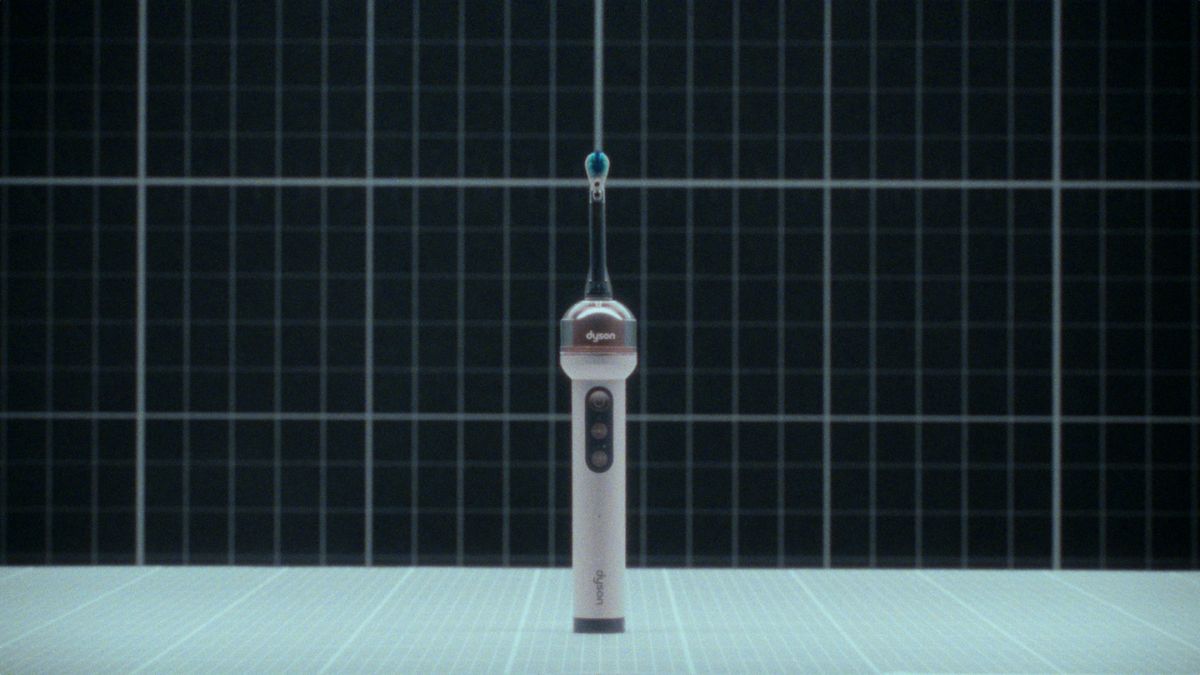
Dyson has spent six years and 661 engineers on a toothbrush. The CameraJet was revealed in Paris on 1 September and is now on Dyson's Australian site at $799 for the full kit. The pitch is simple: most of us don't floss, so the brush finds the gaps between your teeth with a camera and flosses them for you with a burst of liquid, at the same time as it brushes.
Dyson announced the CameraJet on 1 September, with James Dyson doing the reveal in Paris. It went straight on sale the same day through dyson.com, Dyson Demo Stores and selected retailers, and the Australian product pages are live with a $799 price on both colours, Ceramic Ultra Blue and Ceramic Pink. At the time of writing both are listed as out of stock with a notify-me button, so demand or supply, one of the two is tight.
What it actually does
There is a 100k pixel macro camera inside the brush head, about 1mm across, with a small strobe light next to it. Dyson calls the software behind it Gap Optical Targeting. The camera takes 28 images a second and a machine learning model trained on around 470,000 dental images works out where the gaps between your teeth are. When it finds one, the brush fires a small cone-shaped jet of mouthrinse into the gap, up to 0.15ml a go, within about a tenth of a second of the camera seeing it. Dyson's argument is that a needle-style water flosser punches a hole through plaque and leaves the rest, while a wider cone sweeps it off at lower pressure, which is easier on gums.
The mouthrinse lives in a 12.5ml tank in the handle. Dyson says the tank uses a diaphragm and a pressure chamber so it keeps firing properly when the brush is on its side or upside down, which is most of the time when you are doing your back teeth. The dock refills the tank in about three seconds at the press of a button and charges the brush, and a travel case is in the box.
The brushing side is a sonic motor at 245 oscillations a second. Dyson claims its brush varies the angle as it goes so the bristles don't stall against the tooth, which it says is a problem with other sonic brushes. The head has two bristle types, firmer in the middle for stains and softer on the outside for the gumline, and each head carries an RFID tag so the brush knows when it is worn out. A sensitive head is available too.
The app and the privacy question
It connects over 2.4GHz Wi-Fi and Bluetooth to the MyDyson app. In the app you can watch the live camera feed while you brush, use it as an inspection camera, and get coverage maps showing where you are missing. Dyson says images are streamed live and never stored on the brush, in the app or in the cloud, a white light shows when the camera is active, and the camera only runs during auto-jetting or live viewing.
There are three cleaning modes, brush and auto-jet together, jet only, and brush only, plus gentle, variable and deep clean intensities. Dyson Australia lists it as IPX7 water resistant, so shower use is fine, with a battery rated for up to 10 days on Dyson's own usage assumptions, and a two year warranty.
The consumables catch
Dyson has built a whole dental system around this, with its own non-foaming toothpaste and low-foaming mouthrinse. The reason is practical: normal foaming toothpaste blocks the camera's view. A starter kit of both is in the box. Dyson says you can use other brands as long as they are SLS-free gel toothpastes and clear rinses, but the brush is clearly designed to work best with its own. Dyson's Australian page also says the brush only works properly with a genuine Dyson head, so replacement heads, toothpaste and rinse are all ongoing Dyson purchases. I couldn't find Australian pricing for the refills on Dyson's site yet.
What is confirmed and what is a claim
The specs, the modes, the $799 price and the two colours are all straight from Dyson's press release and Dyson Australia's product page. The performance numbers are Dyson's own claims with Dyson's own caveats: the up to 69 percent more plaque figure in hard-to-reach areas is a lab test in brush-only mode, and the gum health claims come from a 71 person clinical test against a manual toothbrush, using Dyson's formulations. Nobody independent has tested it against a good Oral-B or Philips with a separate water flosser yet, and that is the comparison that matters.