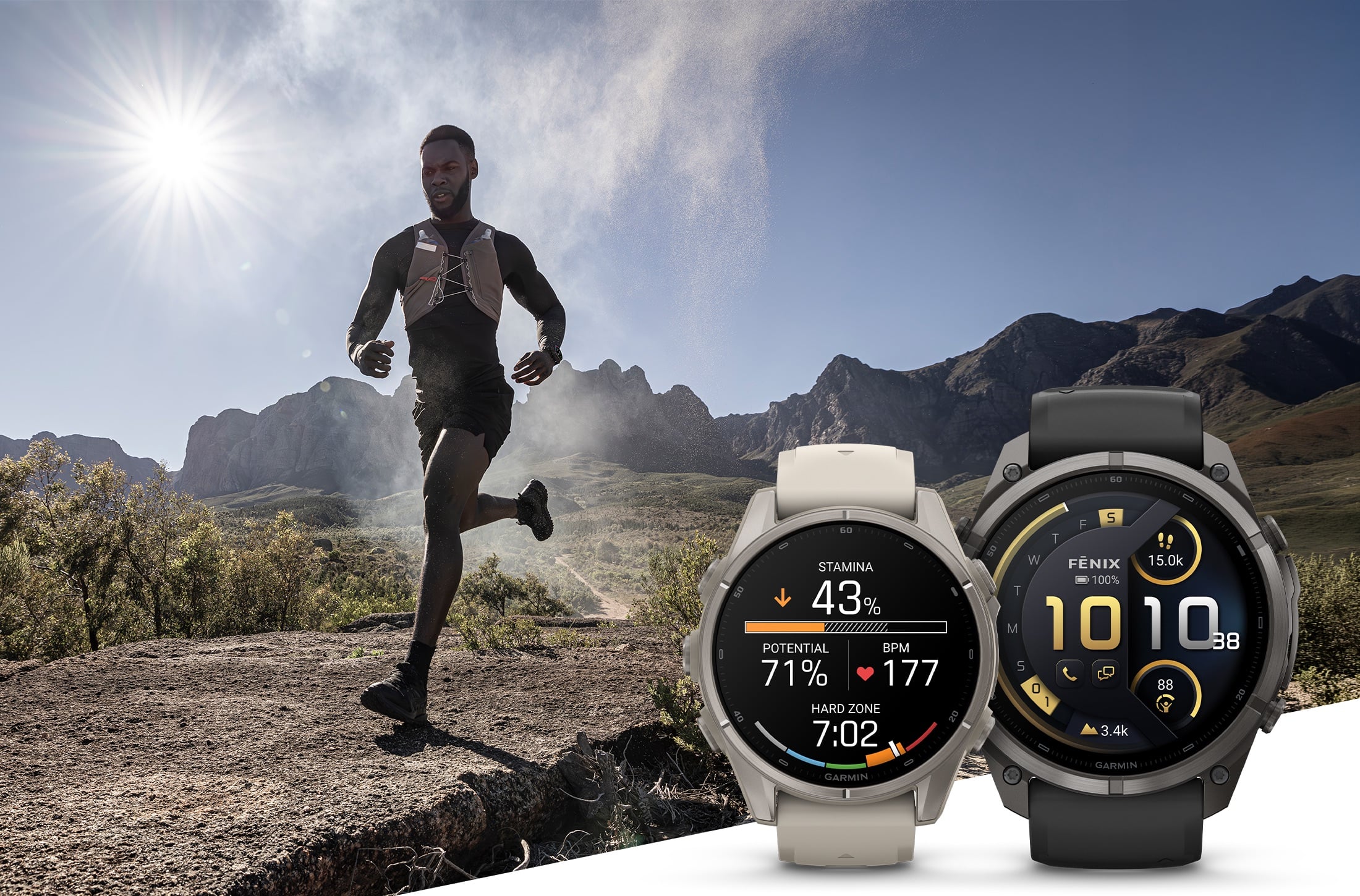
Garmin ran a YouTube launch event at 9pm our time on Tuesday and put two new flagship watches on sale the same day. The Pro model is the headline, but the quieter upgrades are the ones you would actually notice.
Garmin announced the fenix 9 and fenix 9 Pro on Tuesday 25 August and both went on sale immediately. The fenix 9 starts at 999.99 US dollars and the Pro at 1,099.99 US dollars. Garmin's press release quotes those American figures only, and I could not confirm Australian pricing on Garmin's own Australian store when I checked, so I am not putting a number on it here. Any AUD figure floating around today is a retailer estimate until Garmin says otherwise.
What is actually new
The Pro is the first fenix to use a titanium case. Garmin says it bonded metal and plastic at a molecular level using nano-molding, which let it take thickness out of the watch without losing toughness. Pro screens run up to 3,000 nits, and the 51mm Pro carries Garmin's first 1.5 inch AMOLED, a display 15 percent bigger than the fenix 8 in a case that has not grown.
The standard fenix 9 gets an AMOLED that Garmin says is twice as bright as the fenix 8, sitting under a sapphire lens, with leakproof buttons, and it is rated for diving to 40 metres. Both lines come in 43mm, 47mm and 51mm.
The map upgrade is the one that matters
There is 50 percent more RAM than the fenix 8 and a rebuilt map engine, and Garmin reckons panning is up to 30 percent faster. Memory doubles to 64GB, which means twice as many maps and room for around 7,000 songs. A new perspective view adds detail both close up and further out so you can read what is coming. Anyone who has stood on a ridge waiting for a fenix to redraw a map knows why that beats another metric.
New tracking bits
Garmin Epic is free and pulls activities recorded across days, weeks or months into a single story in Garmin Connect, with your health and performance data from that stretch and any photos you add. Stamina tracking picks up stamina zones and a stamina curve, so you can see how your endurance shifts as training builds. Indoor rowing gets real numbers now, including VO2 Max and a power curve, though you need a rowing machine with a power meter to get them. Rucking has been widened too: you can change pack weight mid activity, follow GORUCK workouts on the watch, and set targets with up to 100kg on your back.
Off grid, in every size
Select Pro models carry inReach satellite and LTE for calling, texting and SOS through Garmin's 24/7 Response centre with your phone left at home. This is the first time that has been available across all three Pro sizes, which matters if you have smaller wrists and were previously pushed into a 51mm slab to get it. LiveTrack notifications now come through the Garmin Messenger app over LTE, a new Garmin Locate feature lets family see where you are, and weather forecasts can land on the watch by satellite as well as LTE. All of it needs an active plan, and Garmin notes LTE coverage is not available everywhere, which in this country is not a small footnote.
Battery
Garmin quotes up to 29 days in smartwatch mode for the fenix 9 in the largest size, up to 31 days for the Pro with the biggest AMOLED, and up to 57 days on the solar models. That solar figure assumes all-day wear with three hours a day outside in 50,000 lux conditions, so read it as a best case rather than what you will live with.