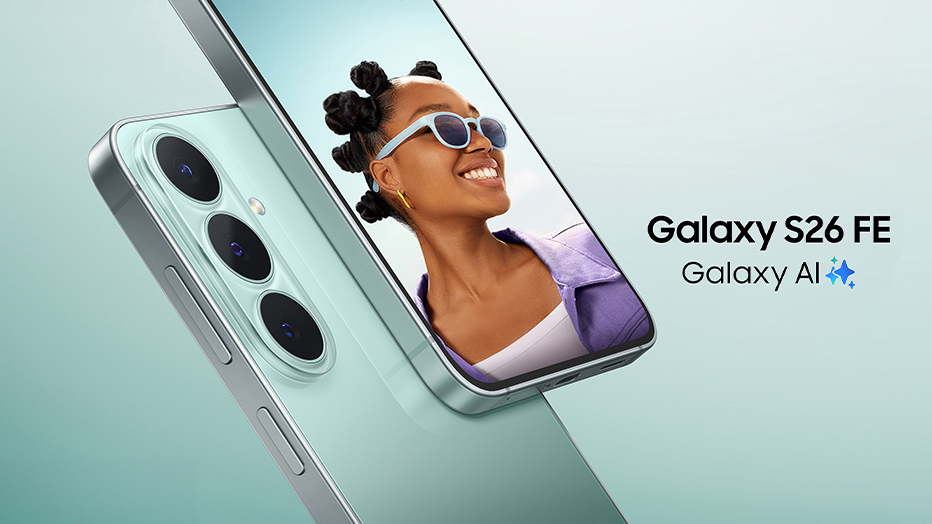
Samsung ran its Galaxy Event overnight our time and the cheap Galaxy S26 is now official, with Australian pricing confirmed on Samsung's own newsroom the same day. The new chip is real. Most of the rest of the phone is the S25 FE again.
Samsung announced the Galaxy S26 FE on 27 August and Samsung Australia published local pricing straight away, which does not always happen. It goes on sale here on 4 September in Blueberry, Graphite and Pistachio.
The recommended prices are $1,149 for 8GB of memory and 128GB of storage, $1,299 for the 256GB, and $1,599 for the 512GB, which only comes in Graphite. Those are Samsung Australia's own figures, not a retailer guess.
What actually changed
The processor. It is an Exynos 2500 built on a 3nm process, where the S25 FE ran an Exynos 2400 on 4nm. That is the one hardware change on the spec sheet that should show up in daily use, in heat and battery more than in raw speed.
It is also the first phone in the S26 family to ship with One UI 9 on Android 17, so it lands with software the S26, S26+ and S26 Ultra are still waiting on.
The front camera opens up a bit. Samsung lists a 12MP selfie camera with an 85 degree field of view against 80 degrees on the S25 FE, so you fit a couple more people in without shuffling backwards.
What did not change
Almost everything else. Same 6.7-inch FHD+ Dynamic AMOLED 2X at up to 120Hz. Same 4,900mAh battery with the same 4,755mAh rated minimum. Same rear camera trio on paper, a 50MP wide with OIS, a 12MP ultra-wide and an 8MP telephoto at 3x optical. Same IP68, same Wi-Fi 6E, same Bluetooth 5.4. It has put on three grams, 193g against 190g.
Charging is 45W wired, 15W wireless and Wireless PowerShare, with the 45W adapter sold separately as usual.
The price, honestly
The S25 FE launched in Australia from $1,099 on 26 September last year. The S26 FE starts at $1,149, so the entry price is up fifty dollars and it arrives three weeks earlier in the year.
Samsung's Australian release for the S25 FE only published a starting price, not a price for each storage tier, so I cannot line the 256GB and 512GB up against last year using Samsung's own numbers. Some outlets are reporting bigger rises further up the range. I have not been able to confirm that from Samsung, so I am not repeating it as fact.
Two Samsung numbers that do not agree
Samsung Australia's release says the phone reaches up to 65 percent in around 30 minutes with the 45W adapter. Samsung's global release, published the same day about the same phone, says up to 69 percent. Same charger, same claim, two different figures.
The dimensions differ too. The Australian release lists 161.1mm tall, the global one lists 161.6mm. Both agree on 76.9mm wide, 7.4mm thick and 193g. Neither gap matters much in your hand, but if you are comparing spec sheets and the numbers will not line up, that is why.
The software side
One UI 9 brings a few things worth knowing. Now Brief lets you build your own briefing cards from a prompt instead of taking what you are given. Now Nudge now works with some third party apps and notifications, not only Samsung's own. Circle to Search can pick out several things in one image at once.
My FanCam comes down from the foldables. It locks onto one person and keeps reframing the video around them as they move, which is aimed squarely at anyone filming kids' sport from the sideline.
Photo Assist edits from plain language prompts and stamps a visible watermark on anything it generates, which is the right call. Gemini Omni, the video editing one, needs a Google AI Pro subscription. Samsung throws in a six month trial and the Australian footnote puts the price at $32.99 a month after that.
Smart Switch has been upgraded so you can scan a QR code and move passwords, passkeys, call history, accessibility settings and eSIM across wirelessly. Coming off an iPhone you need iOS 26.6 or later for it, and eSIM transfer depends on your carrier.
Support runs to seven generations of Android upgrades and seven years of security patches from the global launch date.